
Kausthub Rao2026-06-05T17:08:39+05:30
KNX Will Define India's Luxury Home Market in the Next Five Years
Why developers, architects and integrators are moving to the standard the world’s luxury homes already run on.
India’s luxury real estate market is booming. Penthouse apartments in Hyderabad. Villa townships in Bengaluru. Ultra-premium residences in Mumbai where every square foot is designed to an exacting standard. Developers are spending crores on Italian marble, German kitchens, and imported fittings — and rightfully so.
But walk into most of these homes and press a light switch. It’s a generic plastic plate — the same one you’d find in any ordinary apartment. Crores invested in the finest finishes, and the one surface you touch a hundred times a day was an afterthought.
That’s the gap we exist to close. As the authorised Indian distributor for Europe’s leading KNX brands, Morion brings the same calibre of engineering and design to the controls, keypads, and automation that the rest of the home already deserves.
That is about to change — and KNX is the reason why.
What KNX Actually Is?
KNX is not a brand. It is not a product you buy off a shelf. KNX is an open international standard for building automation — the same standard used in every serious luxury project across Europe, the Middle East, and Singapore for the past three decades.
It is the protocol that governs how every device in a building — lights, climate, blinds, audio, security, intercoms — communicates with every other device. Through a single dedicated wire. Without the internet. Without a cloud server in another country. Without an app that stops working after the next iOS update.
Over 500 manufacturers build KNX-certified products — MDT Technologies, Siemens, ABB, Schneider Electric, and many more — all speaking the same KNX language. That means you’re never locked into one brand, one installer, or one ecosystem. You build once, and you build right.
Why India Has Been Slow to Adopt It
The honest answer is that India’s automation market grew up on the wrong foundation.
The first wave of “smart homes” in India was a luxury only ultra-high-net-worth individuals could afford. The second wave brought products to market at a lower price — but with lower quality and less reliability — and this is where wireless comes in: consumer electronics like Wi-Fi smart plugs, app-controlled bulbs, and voice assistants. These products are cheap, easy to install, and impressive at a product demo. They aren’t suited to serious commercial automation, or to bigger residential homes — though for smaller, budget-friendly houses, wireless does the job well.
They depend on internet connectivity. They require manufacturer cloud servers to stay operational. They are updated unilaterally — meaning a firmware push from a company in Shenzhen can break your entire lighting system overnight. And when the manufacturer discontinues the product line, or gets acquired, or simply shuts down — your investment walks out the door with them.
Integrators who built businesses on these platforms are now quietly rebuilding them. Developers who specified these systems in premium projects are fielding complaints from residents. The cracks are showing.
Why the Next Five Years Belong to KNX
Three things are converging right now that will make KNX the dominant standard in India’s luxury segment.
- The developer mindset is shifting. Premium developers — the ones building ₹5 crore and above residences — are being asked harder questions by buyers. Buyers who have lived in Singapore, Dubai, or the USA, who have experienced real KNX-based and wired automation (common in the USA), and who will not accept a Wi-Fi hub and an Alexa as a substitute. Specification is moving upstream, into the architect and interior designer brief, and the brief is getting more demanding.
- The integrator ecosystem is maturing. India now has a growing community of KNX-certified professionals. These are engineers who have trained to the same international standard as their counterparts in Germany or Belgium. They can read a KNX project file, pick it up if another integrator hands it over, and expand it years later without starting from scratch. That professional continuity is something Wi-Fi systems simply cannot offer.
- The cost conversation is changing. KNX costs more upfront than a consumer smart home system. That has always been true and will continue to be true. But the total cost of ownership over ten years — factoring in replacements, re-installations, troubleshooting, and the eventual obsolescence of consumer platforms — tells a very different story. The buyers who matter in the luxury segment are increasingly making that calculation correctly.
What This Means for Developers, Architects, and Integrators
If you are developing luxury residential projects, the specification window for automation is right now — during construction, before the walls are closed. KNX requires dedicated cabling. Retrofitting is expensive. The developers who get ahead of this conversation will deliver projects that genuinely stand apart.
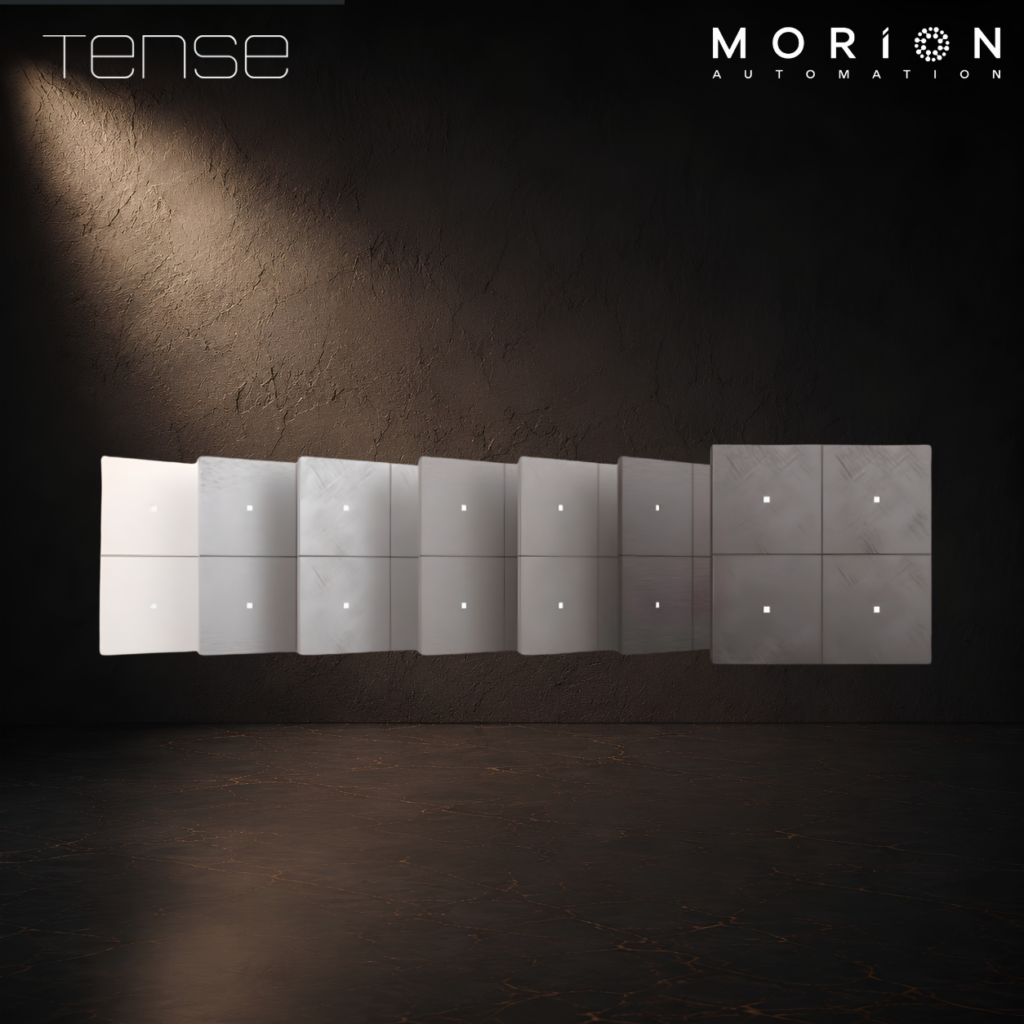
If you are an architect or interior designer, the light switch on the wall is a design element. It is the most touched surface in any room. The difference between a generic plastic plate and a Belgian TENSE keypad flush-mounted on a hand-plastered wall is visible, tangible, and felt by the client every single day. That detail matters.
If you are a KNX integrator — or considering becoming one — India is at the beginning of a significant growth curve. The projects that need KNX are being built right now. The clients who want it are asking for it by name.
The Role of a Distributor in This Shift
Morion exists because someone needs to bridge the gap between world-class European engineering and the Indian market. We are the authorised Indian distributor for MDT Technologies, TENSE, 1Home, Trivum, Fasttel, and Displine — the brands that define what KNX looks like at its best.
Our job is not to compete with integrators. It is to equip them — with the right products, the right technical knowledge, and the right support to deliver projects that will still be working flawlessly twenty years from now.
India’s luxury homes deserve the same standard that the rest of the world’s luxury homes already have. KNX is that standard. The next five years will make that clear.
Morion Automation is India’s authorised KNX distributor, based in Hyderabad. We supply MDT Technologies, TENSE, 1Home, Trivum, Fasttel, and Displine to KNX integrators across India. Visit morion.in
Morion Automation Launches
Discipline Mounts in India
KNX India, KNX automation India, luxury home automation India, smart home automation India, KNX distributor India, KNX standard India, home automation Hyderabad, KNX integrator India, luxury smart home India, building automation India, KNX certified India, KNX will define India luxury home market, best smart home system for luxury homes India, why KNX is better than WiFi smart home, KNX vs WiFi home automation India, authorised KNX distributor India, Morion Automation, MDT Technologies India, TENSE keypad India, 1Home India, Trivum India, Fasttel India, Displine India, KNX, smart home, home automation, luxury real estate India, building automation standard, open protocol, future-proof smart home

Leave a Reply